How Does a Font Generator Work? The Unicode Secret Behind Fancy Text
You type your name into a font generator, and a few milliseconds later you see it rendered in fifty different styles. You tap one, copy it, paste it into Instagram, and it looks exactly the same. No font was downloaded. No app was installed. The styled text just works — on every device, in every app.
How does that happen? The answer is surprisingly simple, and understanding it will completely change how you think about text on the internet.
Start Here: What Is a Font?
A font is a file. It is a file that tells your computer or phone how to draw each letter, number, and symbol when displaying text. When you install a font on your computer and write text in that font in Microsoft Word, the font file is doing the work of rendering each letter in the shape the designer specified.
The problem with fonts is that they only work when the viewer has the same font installed. If you send someone a Word document in a custom font and they do not have that font on their device, they see the text in a completely different font — or in a generic fallback. The styled look does not transfer.
This is why you cannot change your Instagram font from within Instagram. Instagram does not let you apply a custom font file to your bio text, because they cannot guarantee every person who reads your profile has that font installed on their device.
Font generators completely bypass this limitation. They do not use font files at all.
The Real Answer: Unicode Characters
Every letter, number, punctuation mark, emoji, and symbol you see on a screen is represented by a number. That number is its Unicode code point — a unique identifier assigned by the Unicode Consortium, the organization that maintains the Unicode Standard.
The letter “A” is Unicode code point U+0041. The letter “a” is U+0061. The fire emoji is U+1F525. Every device on the planet that displays text uses Unicode to determine which character to show when it receives a specific code point.
Now here is the key insight: the Unicode Standard contains over 140,000 characters. And within those 140,000 characters, there are dedicated sets of letters that look like different styles — bold, italic, script, Gothic Fraktur, double-struck, and more.
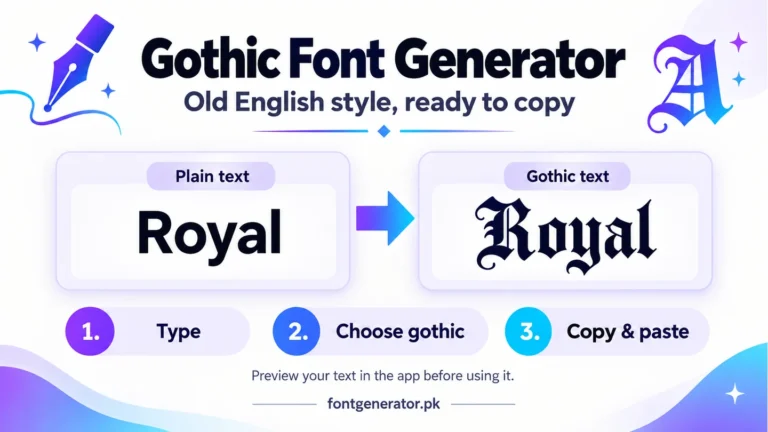
The character U+1D400 is not a styled version of the letter A. It is its own separate character — Mathematical Bold Capital Letter A — that happens to look like a bold A. The character U+1D49C is Mathematical Script Capital Letter A. The character U+1D504 is Mathematical Fraktur Capital Letter A. The official Mathematical Alphanumeric Symbols chart (PDF) documents these characters; our cursive guide and gothic guide show practical uses.
These are different characters, not the same character with different formatting applied to it.
What a Font Generator Actually Does
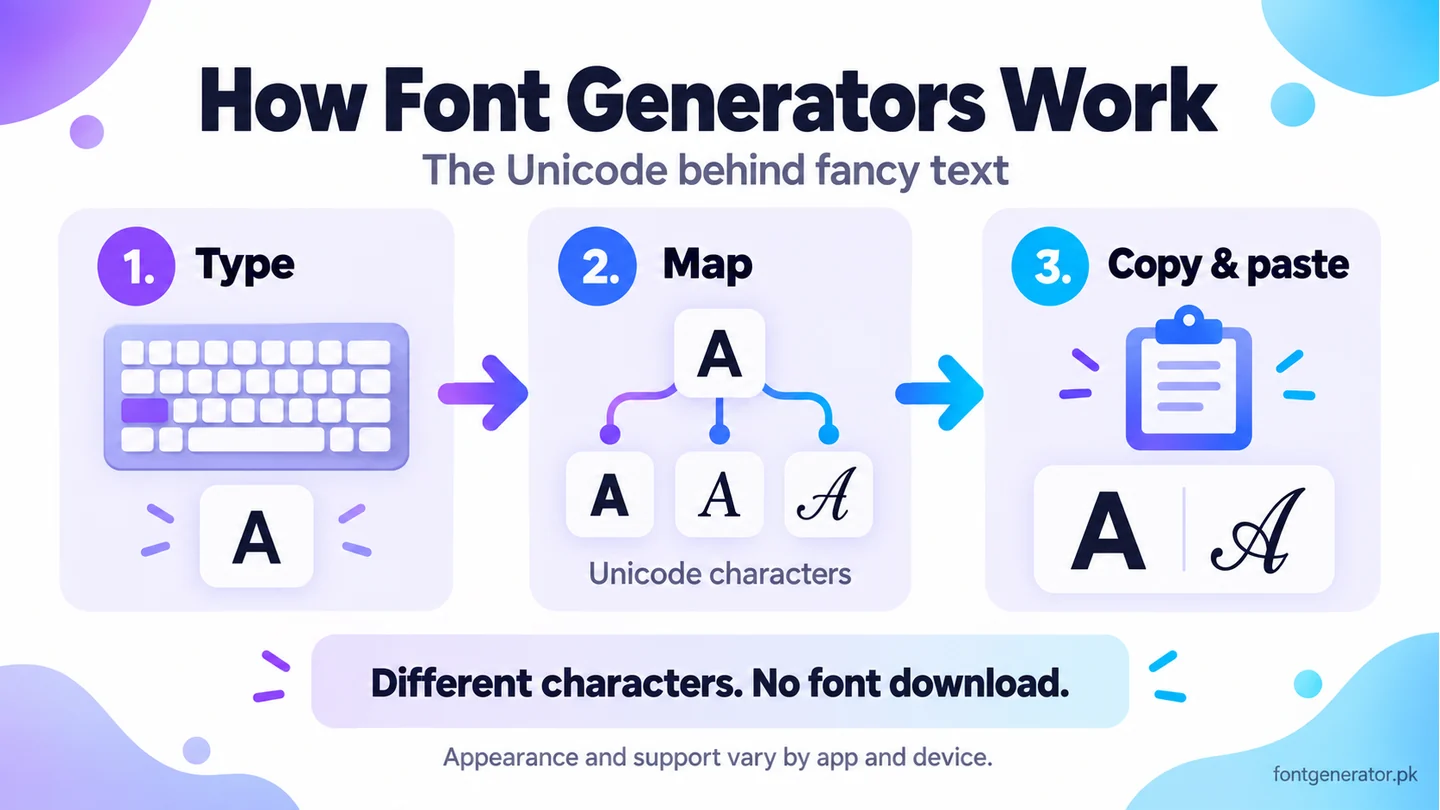
A font generator maintains a lookup table — a mapping from every standard ASCII letter (A to Z, a to z, 0 to 9) to its equivalent character in each Unicode style block.
When you type the word “hello” into a font generator, the tool:
- Takes each input character (h, e, l, l, o)
- Looks up the corresponding Unicode character for that letter in each supported style
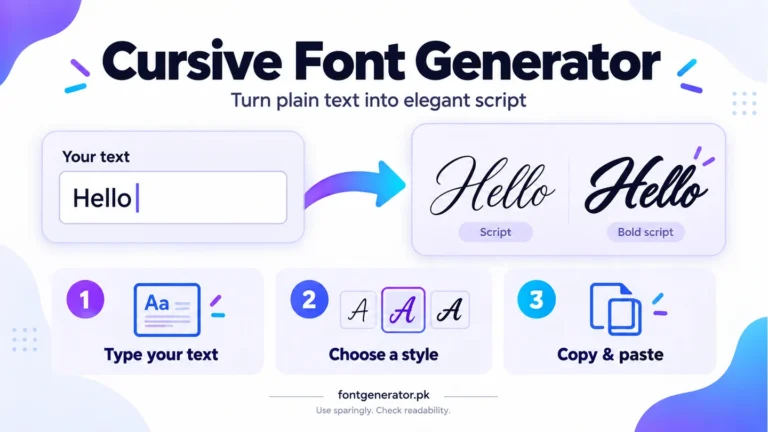
- Returns the output string in each style — for example, script style, bold script style, and Fraktur style versions of the word
The output is a sequence of Unicode code points. When you copy it, you copy those code points. When you paste it into Instagram, Discord, WhatsApp, or anywhere else, the receiving app reads those code points and displays the appropriate character — which happens to look like a styled version of the original letter.
Because the Unicode Standard is universal, every device renders those characters the same way. That is why the text looks identical when you paste it into an iPhone, an Android device, a Windows PC, or a Mac. They all know how to render the same Unicode code point the same way.
Why Some Characters Are Not Available
Not every letter has a corresponding character in every Unicode style block. The Unicode mathematical alphabet blocks were originally designed for use in mathematical notation, so they cover the complete A to Z and a to z ranges — but a small number of letters use pre-existing Unicode characters rather than dedicated positions in the math block.
For example, the Mathematical Fraktur block does not have dedicated characters for C, H, I, R, and Z in uppercase. Those positions use other existing Unicode letters that approximate the look. A good font generator handles these gaps automatically, substituting the closest available character so the output still looks consistent.
Numbers and punctuation marks are also not always available in styled Unicode variants. Most font generators either leave numbers in their standard ASCII form or use numerals from a specific Unicode block — like enclosed numbers for bubble text.
Unicode Style Blocks Used by Font Generators
Mathematical Alphanumeric Symbols (U+1D400 to U+1D7FF)
The primary source for most styled text. This block contains bold, italic, bold italic, script, bold script, Fraktur, bold Fraktur, double-struck, sans-serif, bold sans-serif, italic sans-serif, bold italic sans-serif, and monospace variants of the full Latin alphabet. This block is why font generators can produce so many different styles from a single input.
Enclosed Alphanumerics (U+2460 to U+24FF)
This block contains circled letters and numbers — the source for “bubble text” styles where each character appears inside a circle.
Letterlike Symbols (U+2100 to U+214F)
Contains a small set of special styled characters that appear frequently in formal and aesthetic text contexts.
Combining Diacritical Marks (U+0300 to U+036F)
These are not letters themselves but modifiers that attach to the preceding letter. They are what produce effects like strikethrough text, overlines, underlines, and the scattered mark effects in Zalgo or “corrupted” text styles. When you generate glitch text or Zalgo text, the generator adds multiple combining marks to each letter, creating the distorted visual effect.
Fullwidth Latin Letters (U+FF01 to U+FF5E)
Wide-spaced versions of Latin letters and numbers. Used to create the “full-width” text style that looks like vaporwave or aesthetic text.
Why This Text Works Everywhere
The Unicode Standard is implemented in essentially every modern operating system, browser, and app. When a developer builds an app — whether it is Instagram, Discord, WhatsApp, TikTok, or a game — they are using the Unicode standard to handle text. That means any valid Unicode character, including the mathematical alphabet characters used in font generators, is treated as regular text by those apps.
The apps do not see “a styled letter.” They see a Unicode code point. They render it the same way they render any other character. The styled appearance comes from what that code point represents — and every Unicode-compliant system renders the same code point the same way.
This is fundamentally different from using a custom font file. Font files require installation. Unicode characters require nothing — they are already part of the universal standard that the device already knows how to use.
The Difference Between Unicode Styled Text and Markdown
Markdown is a lightweight formatting syntax used in apps like Discord, Reddit, Notion, and others. When you write bold text syntax in a Markdown-enabled app, the app displays it as bold text — but only inside that app. Copy the text out of Discord and paste it somewhere else, and you see the raw syntax, not bold formatting.
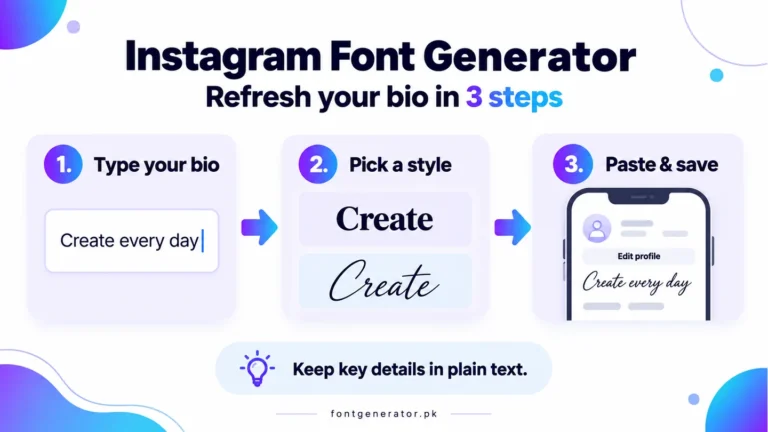
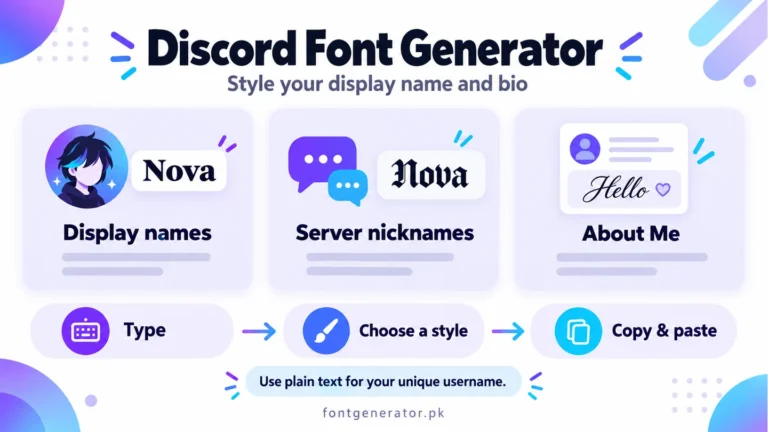
Unicode styled text works the opposite way. The bold or italic appearance is embedded in the characters themselves — in the code points. Copy the text anywhere, and it stays styled. It works in Discord messages, Instagram bios, WhatsApp messages, Twitter posts, and plain text files equally, because every Unicode-compliant system renders those code points the same way.
This is why Unicode font text from a generator is more portable than Markdown formatting. And it is why it works in places like Instagram bios, where Markdown has no effect at all.
What Font Generators Cannot Do
Font generators only work with Latin script. The Unicode mathematical alphabet blocks contain Latin letters only. If you want to style Arabic, Devanagari, Cyrillic, or other scripts, the relevant style variants do not exist in Unicode — with very limited exceptions. Font generators only produce styled output for text entered in English/Latin characters.
Not every app supports every Unicode block. Most major apps support the full Unicode range, but some niche platforms, older apps, or games with restricted character sets will display unsupported characters as boxes or question marks. Test before committing to a styled name in a specific platform.
Screen readers interpret Unicode characters literally. A screen reader may read out “Mathematical Bold Capital Letter A” instead of just “A” when it encounters a Unicode styled character. This makes Unicode styled text inaccessible for users who rely on screen readers. For web page body content, always use standard text. Use Unicode styled text only in social media fields, usernames, and decorative contexts.
Search engines may not index styled text the same way. Google’s crawlers can read Unicode characters, but a mathematical Fraktur letter is not the same character as its standard version in Unicode. If you use Unicode styled text in your website’s headings or body content, Google will index those characters — but they will not match standard text search queries. For SEO purposes, always use standard characters in your web content.
The Practical Takeaway
A font generator does not change fonts. It changes characters. You are swapping standard Latin letters for visually similar characters from other Unicode blocks — characters that look like stylized versions of those letters but are technically different entities in the Unicode table.
Because these are just Unicode characters, they work everywhere Unicode is supported — which is everywhere that matters: Instagram, Discord, WhatsApp, TikTok, Twitter, Facebook, most games, and virtually every modern app on every major platform.
It is one of the most elegant uses of the Unicode Standard that most people never think about. A decades-old universal text encoding system happens to contain enough character variety to let anyone produce styled text without fonts, apps, or design skills.
Try it yourself. Go to our font generator, type anything, and copy a style you like. It works because Unicode works — and Unicode works everywhere. For field-specific steps, follow our Instagram bio guide or Discord display-name guide.